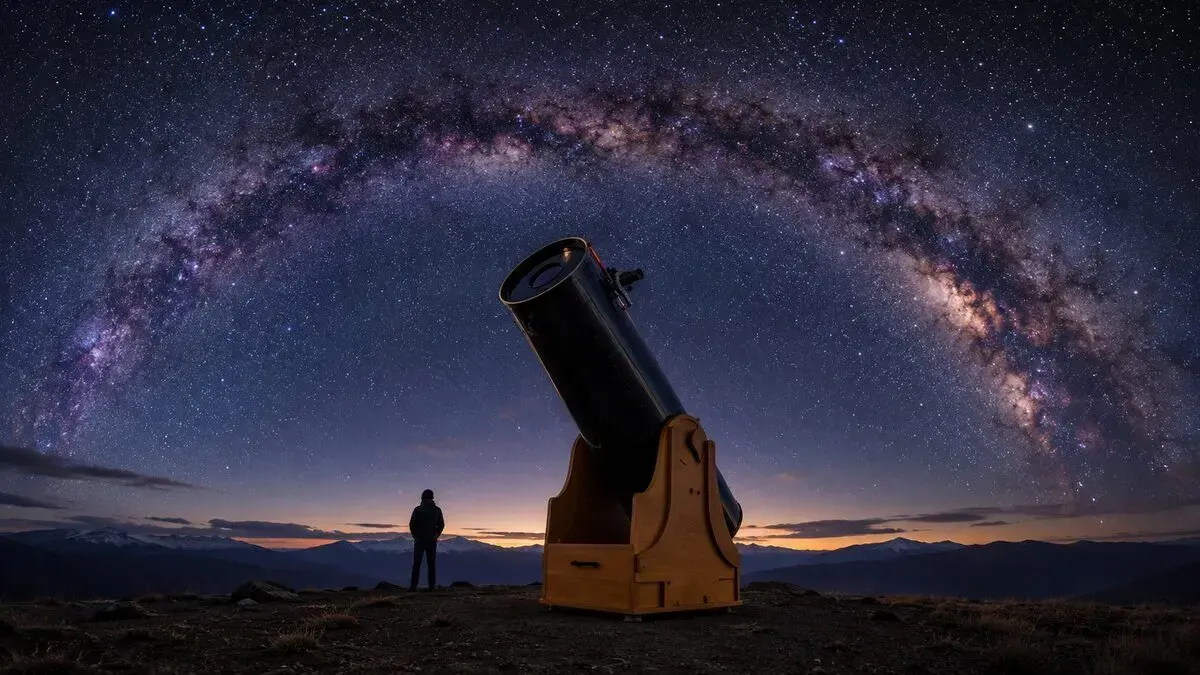
A dobsonian telescope is the single most recommended first telescope in all of amateur astronomy — and the reason is refreshingly simple: it gives you more light-gathering aperture for your money than any other design on Earth. But here is the part that confuses almost every beginner: a Dobsonian is not a separate kind of optics. It is a standard Newtonian reflector tube sitting on a clever, low-cost altazimuth base called a rocker box. The word “Dobsonian” describes the mount, not the mirrors.
Quick answer: A Dobsonian telescope is a Newtonian reflector mounted on a simple wooden alt-azimuth rocker box, a design popularized by John Dobson in the late 1960s. Because the mount is cheap to build, almost your entire budget goes into a big mirror — making Dobs the best aperture-per-dollar and the best beginner telescope for visual observing. The trade-off: an alt-az mount does not track the sky, so Dobs are excellent for visual, lunar, and planetary viewing but poor for long-exposure astrophotography.
What this guide covers
What is a Dobsonian telescope?
A Dobsonian is a Newtonian reflecting telescope — a tube with a concave primary mirror at the bottom and a small flat secondary mirror near the top — placed on a box-shaped mount that swivels left–right (azimuth) and tips up–down (altitude). That is the whole idea. There is no German equatorial head, no tripod legs, no motor required. You point it like a cannon and nudge it by hand.
For the optics themselves, a Dob is identical to any other Newtonian, so everything in our reflector telescope guide applies directly: the same parabolic primary mirror, the same secondary, the same eyepiece poking out the side near the top. If you want to understand how the light path works, read that guide — this page is about the mount and the practical reality of owning one.
Where a Dobsonian differs from a tripod-mounted Newtonian is purely structural. John Dobson's insight was that the expensive, heavy, fiddly equatorial mount most people bolted under a reflector was overkill for casual visual observing. Replace it with a plywood box riding on Teflon pads, and the savings can be poured into a far larger mirror instead.
Why a Dobsonian is the best value — and the best beginner telescope
In a telescope, aperture is king. The diameter of the primary mirror determines two things that matter most: how much light the instrument collects (brightness of faint galaxies and nebulae) and its theoretical resolving power (fine detail on the Moon and planets). Light-gathering scales with the area of the mirror, so an 8-inch Dob collects roughly 78% more light than a 6-inch, and an 8-inch gathers somewhere around 850–1,150 times more light than your dark-adapted eye, depending on your pupil size.
The Dobsonian mount is what makes that aperture affordable. A quality equatorial mount sturdy enough to carry an 8-inch tube can cost as much as the optics it holds. A rocker box costs a fraction of that. So when you spend, say, $400–$700 on a Dob, the overwhelming majority of that money is buying glass — not engineering you do not need for visual work.
The beginner advantages
- Intuitive aiming. Up, down, left, right. There is no polar alignment, no counterweights, no learning which way the right-ascension axis points. A child can aim it.
- Fast setup. Carry the base out, drop the tube in, and you are observing in under a minute. No tripod to level, no battery to charge.
- Stability. A low, wide rocker box sitting on the ground is far steadier than a tall tripod, so the image does not shudder every time you touch the focuser.
- Maximum “wow” per dollar. Big aperture means the Moon's craters, the rings of Saturn, the cloud belts of Jupiter, and hundreds of deep-sky objects all become genuinely impressive rather than faint smudges.
For a fuller breakdown of how aperture, focal length, and focal ratio trade against one another, see the specs that matter section of our telescopes pillar guide.
How a Dobsonian works
The optical engine is pure Newtonian, the design Isaac Newton built in 1668. Light enters the open top of the tube and travels all the way down to a concave parabolic primary mirror. That mirror reflects and focuses the light back up the tube, where a small flat secondary mirror, tilted at 45 degrees, bounces it out through a hole in the side of the tube into your eyepiece — which is why you look into the side near the top of a Dob, not the back.
The rocker box
The mount is two nested wooden structures. The tube sits in a U-shaped cradle that pivots up and down on two side bearings (the altitude axis). That cradle sits inside a square base that rotates on a flat ground board (the azimuth axis). Both axes glide on slippery Teflon-against-laminate pads, so the scope moves smoothly under light hand pressure but stays put when you let go. There are no gears and no locks — the friction itself holds your aim.
Because both motions are independent — one purely horizontal, one purely vertical — the mount is called altazimuth (altitude-azimuth). This is the same simple geometry as a camera tripod head, and it is the source of both the Dob's great strength (cost, simplicity) and its one real limitation (tracking), which we cover below. You can read more about mount types in the telescope mounts section of the pillar.
One quirk every new owner notices: eyepiece height
Because the eyepiece sits near the top of the tube, its position swings around the tube as you change altitude. Aim near the zenith and the eyepiece is high; drop toward the horizon and it sinks low, so tall observers end up bending over. An adjustable observing chair or stool transforms the experience, and many owners loosen the tube in its rings to rotate the focuser to a comfortable angle. It is worth knowing before your first night, because it surprises nearly everyone. One optical note for the detail-minded: fast Dobs (around f/4–f/5) show a little coma — comet-like flaring of stars at the very edge of the field — which a coma corrector removes if pristine wide fields matter to you.
Dobsonian aperture sizes and what each one shows
Dobsonians come in a wider range of apertures than almost any other type, from palm-sized tabletop scopes to backyard giants. Here is a realistic guide to what each size delivers under a reasonably dark sky.
Tabletop Dobs (3–5 inch / 76–130 mm)
These compact scopes sit on a table or a sturdy box rather than the ground. A 100–130 mm tabletop Dob is a superb grab-and-go first instrument and a popular gift: it shows lunar craters in crisp detail, the four Galilean moons of Jupiter, Saturn's rings as a distinct shape, the brightest star clusters, and the Orion Nebula. Aperture is modest, so faint galaxies stay dim.
The classic 6-inch and 8-inch
The 8-inch (200 mm) Dob is the most recommended “forever” first telescope in the hobby, and for good reason. It is large enough to reveal cloud bands and the Great Red Spot on Jupiter, Cassini's Division in Saturn's rings, dozens of Messier galaxies and globular clusters, and the structure of bright nebulae — yet still light enough for one person to carry in two pieces. (For a typical 8-inch, the tube weighs roughly 20 lb and the base another 20 lb or so, which is exactly why the two-piece carry works.) A 6-inch is a slightly more portable, slightly less capable sibling that remains an excellent value.
10-inch, 12-inch and beyond
A 10–12-inch (250–300 mm) Dob pushes into serious deep-sky territory: spiral arms in brighter galaxies like the Whirlpool Galaxy (M51) and M106 from a dark site, fainter planetary nebulae, and far more detail on Mars and Jupiter. From 16 inches (400 mm) up, you reach “light bucket” territory where galaxies show texture and color hints appear in the brightest nebulae — but these instruments are large, heavy, and usually break down into a truss for transport.
Solid-tube vs collapsible, truss, and FlexTube
As aperture grows, so does tube length, and a long solid tube quickly becomes awkward to fit in a car. Manufacturers solve this with three approaches.
- Solid tube. One rigid tube. Simplest, most rigid, best at blocking stray light, and it holds collimation well. Ideal up to about 8 inches; a solid 10- or 12-inch tube is long and bulky.
- Collapsible / FlexTube. The upper section slides down three struts to shorten the scope by roughly a quarter to a third of its assembled length for transport, then extends and locks for use. “FlexTube” is Sky-Watcher's trademarked version. A practical middle ground for 8–14-inch scopes that still fit a hatchback.
- Truss-tube. The optics live in two separate boxes — a mirror box and an upper cage — joined by removable poles. The whole telescope disassembles into compact pieces, making 16-inch and larger apertures genuinely portable. The trade-off is more setup time and a need to re-check collimation after each assembly, plus a light shroud to keep stray light out.
The tracking reality: do Dobsonians track the sky?
Short answer: no, a standard Dobsonian does not track. Earth rotates, so every object drifts steadily across your eyepiece — faster at high magnification. With a plain Dob you simply nudge the tube every 15–60 seconds to recenter the target. Most observers do this without thinking, but at 200× or more on a planet it takes a little practice.
The reason is the altazimuth geometry. To follow a star, an alt-az mount must move in both axes simultaneously at constantly changing rates — mechanically awkward for an unpowered wooden box. An equatorial mount, by contrast, tilts one axis to match Earth's pole so a single steady motor can track. There are several ways to add tracking or aiming help to a Dob:
- Equatorial platform. A motorized wedge that sits under the rocker box and slowly tilts the entire telescope to cancel Earth's rotation for roughly an hour before it must be reset. This gives a plain Dob true tracking for high-power viewing and even short imaging runs — though that hour-long limit and residual field rotation cap how much deep-sky imaging it enables (see the astrophotography section).
- Smartphone plate-solving push-to. Systems like Celestron's StarSense Explorer clamp your phone to the scope and use its camera to read the star field and show a live arrow guiding you to any target — no encoders, no motors, no power to the optics. It is the cheapest “find-it-for-me” upgrade and the most beginner-friendly way to locate objects without a star chart.
- Push-to (digital setting circles). Encoders on both axes feed an app or handset that points an arrow telling you which way to push. You still move the scope by hand, but it finds targets for you.
- GoTo Dobsonians. Motors on both axes slew to any object from a database and then track it automatically. This adds cost and a power requirement but keeps the rocker-box form factor.
Astrophotography with a Dobsonian
A standard Dobsonian is poor for long-exposure deep-sky astrophotography but excellent for visual observing, lunar and planetary imaging, and electronically-assisted astronomy (EAA).
The problem for deep-sky imaging is the lack of tracking. Capturing faint galaxies and nebulae requires exposures of many minutes, during which the camera must follow a star to better than an arcsecond — impossible on an untracked alt-az mount, where stars trail in seconds. Even with an equatorial platform, the limited run-time and residual field rotation make a Dob a frustrating choice for the long-exposure work covered in our astrophotography fundamentals guide. For that, an equatorial-mounted scope is the right tool.
Where a Dob shines with a camera:
- Lunar and planetary imaging. The Moon, Jupiter, Saturn, and Mars are bright, so you shoot thousands of frames in a few seconds with a high-speed camera and “stack” the sharpest ones. Brief exposures sidestep the tracking problem, and a big Dob mirror delivers superb resolution.
- EAA (electronically-assisted astronomy). A sensitive camera takes a rapid sequence of short exposures (sub-second on an untracked Dob, specifically to avoid trailing) that software live-stacks on a screen, revealing color and faint detail the eye cannot see — all without precise tracking.
If you want to understand how sensor and optics combine to set your resolution before you shoot, our pixel scale explainer walks through the arcsec-per-pixel math — but for serious deep-sky imaging, choose an equatorial setup and keep the Dob for the views.
Collimation, cool-down, and caring for your Dob
Because a Dob is a Newtonian, it shares the Newtonian's one routine maintenance task: collimation, the alignment of the primary and secondary mirrors so the light cone lands precisely in your eyepiece. Mirrors can drift slightly out of alignment from transport, temperature, or simply over time, softening the image.
The good news is that collimating a Dob is quick once learned — a few minutes with an inexpensive laser collimator or a Cheshire eyepiece, adjusting two or three thumbscrews behind the primary. Solid-tube Dobs hold collimation well and often need only an occasional touch-up; truss Dobs benefit from a quick check at each setup. It is a skill, not a chore, and most owners come to do it almost automatically.
Cool-down: let the mirror reach ambient temperature
This is the single biggest cause of disappointing high-power views, and it has nothing to do with collimation. A large glass primary stores heat, and until it cools to match the night air it sheds a thin boundary layer that creates “tube currents” — swirling warm air that smears fine detail on the Moon and planets. An 8-inch typically needs 30–60 minutes outside before it settles; 10–12-inch mirrors take longer still because more glass means more heat to dump. Many larger Dobs include a rear fan that blows on the back of the mirror to speed equilibrium. If your planet views look mushy at high power, suspect a warm mirror (or unsteady atmosphere) before you blame the optics.
Caring for your Dobsonian
Routine mirror care is mostly about leaving the mirror alone. Clean it rarely and gently — a little dust barely affects the image, and over-cleaning is the fastest way to scratch the aluminized coating. Store the scope with its caps on in a dry place to protect those coatings, and after a damp session let any dew evaporate before you seal everything up, so you do not trap moisture inside. Done right, a Dobsonian's coatings last many years, and even a tired mirror can be professionally re-coated rather than replaced.
Essential accessories for a Dobsonian
Stock Dobs usually ship with one or two basic eyepieces and a so-so finder, so a handful of inexpensive additions make an enormous difference to what you actually see and how easily you find it.
- A low-power and a high-power eyepiece. Magnification equals the telescope's focal length divided by the eyepiece focal length, so a 1200 mm scope with a 25 mm eyepiece gives 48×, and a 6 mm gives 200×. You want a wide-field low-power eyepiece (ideally 2-inch) for finding targets and framing big deep-sky objects, plus a short high-power eyepiece for the Moon and planets. See the specs that matter section for how focal length and focal ratio shape magnification.
- A better finder. A Telrad or Rigel reflex finder, or a simple red-dot finder, makes aiming dramatically easier than the stock optical finder by projecting a target ring on the sky.
- A collimation tool. A laser collimator or a Cheshire eyepiece so the two-minute alignment above is painless.
- A nebula filter. A UHC or OIII filter dramatically improves emission nebulae from light-polluted backyards by blocking skyglow while passing nebula wavelengths.
- A red headlamp and a sky guide. A red flashlight preserves your dark adaptation, and a planisphere or star-hopping app helps you navigate the sky by eye if you do not have a push-to system.
How to choose a Dobsonian size (and new vs used)
The honest rule of the hobby is: the best telescope is the one you will actually use. A 16-inch monster that lives in the garage because it is too heavy to haul out shows you nothing. Weigh these four practical factors before chasing maximum aperture.
- Storage. Where will it live between sessions? An 8-inch solid tube needs about the footprint of a tall kitchen bin; a 12-inch is a piece of furniture.
- Transport. Will it fit your car? A solid 8-inch (tube around 20 lb, base around 20 lb) fits most back seats in two pieces. For a 10-inch and up, look at a collapsible or truss design, or measure your trunk first.
- Dark-sky access. If you observe mostly from a light-polluted yard, extra aperture helps less than escaping the glow. If you can reach dark skies, a bigger mirror rewards the drive.
- Budget. Decide your total spend, then buy the most aperture you can carry and store within it. An 8-inch Dob is the classic sweet spot of capability, portability, and price.
For most beginners who want one telescope that will satisfy for years, an 8-inch Dobsonian is the default answer. Step up to 10–12 inches only if storage, car, and back can handle it.
Brands and the used market
On the new side, the mainstream value lines are easy to find: Sky-Watcher, GSO-based scopes (sold under names like Apertura and others), Orion-style Dobs, and Celestron's StarSense Explorer Dobs with phone-assisted push-to. Optically these are far more alike than different, so buy on aperture, mechanics, and included accessories rather than badge.
Dobs are also a classic used-market buy, because the design is simple and the optics hold their value — a 10-inch used can cost what a new 8-inch does. If you shop second-hand, check three things: the mirror coatings (light dust is fine, but heavy pitting or peeling is not — though coatings can be professionally re-applied), that both bearings move smoothly without sticking, and which eyepieces and finder are included, since those add real value. A simple, robust scope with good glass is a safe used purchase.
Dobsonian vs Newtonian vs refractor
The most common point of confusion is “Dobsonian vs Newtonian.” They are not competing optical designs — a Dobsonian is a Newtonian. The difference is the mount: a Newtonian can sit on a tripod with an equatorial or alt-az head, while a Dobsonian sits on a rocker box. Same mirrors, same light path, different base.
Against a refractor telescope, the trade is aperture versus convenience. A refractor uses a lens objective and rarely needs user collimation because the lens cell is factory-aligned and sealed; it gives high-contrast, pin-sharp views and tracks easily on a small mount — but large lenses are extraordinarily expensive, so refractors are usually small in aperture. A Dob delivers several times the aperture for the same money, at the cost of needing collimation and manual tracking. The table below summarizes the choice.
| Feature | Dobsonian (Newtonian on rocker box) | Refractor (on tripod mount) |
|---|---|---|
| Optics | Newtonian reflector (mirrors) | Lens (objective at front) |
| Aperture per dollar | Highest of any design | Lowest — large lenses cost a lot |
| Best for | Visual deep-sky, lunar & planetary | Wide-field, high-contrast, imaging-friendly |
| Tracking | None by default (alt-az); manual nudging | Easy on an equatorial or motorized mount |
| Long-exposure astrophotography | Poor (no tracking) | Excellent on a tracking mount |
| Collimation | Required, routine | Rarely needed (sealed lens cell) |
| Setup & portability | Fast setup; bulky at large apertures | Compact; quick to deploy |
| Typical entry cost | Low for big aperture (8″ ~$400–$700) | Higher per inch of aperture |
If you want to see how both fit into the wider family of designs — including catadioptric scopes like the Schmidt-Cassegrain and Maksutov-Cassegrain — the types of telescopes section of the pillar lays them all out side by side.
Who was John Dobson?
John Lowry Dobson (September 14, 1915 – January 15, 2014) was the amateur astronomer who gave the design its name. Born in Beijing, China, and raised in San Francisco, Dobson spent over two decades as a monk in the Vedanta Society. It was there, in the 1950s, that he began grinding his own telescope mirrors and building large scopes from salvaged materials — cardboard tubes, porthole glass, scavenged plywood — with the explicit goal of letting ordinary people see the universe.
Dobson did not patent his mount or claim to have invented its individual parts; his genius was combining cheap, available materials into a stable, easy-to-build telescope that anyone could replicate. In 1968 he co-founded the San Francisco Sidewalk Astronomers, setting up his big homemade scopes on city street corners and inviting passersby to look. That “sidewalk astronomy” movement — dragging telescopes to where people already are — spread worldwide and remains his lasting legacy alongside the mount that bears his name. You can read more about him and other pioneers on our famous astronomers hub.
The optical principle Dobson exploited was over three centuries old. Isaac Newton built the first working reflecting telescope in 1668 to sidestep the color fringing of early lenses. Dobson's contribution was not the optics but democratizing them: a way to put a big mirror in everyone's hands for the price of some plywood. NASA's introduction to how reflecting telescopes gather light shows the same mirror principle scaled all the way up to space.
Frequently asked questions
Is a Dobsonian good for beginners?
Yes — a Dobsonian is widely considered the best beginner telescope. It is intuitive to aim (just up, down, left, right), fast to set up, very stable, and gives you the most aperture for your money, so you see impressive views from the first night. An 8-inch Dob is the classic first-telescope recommendation.
What is the difference between a Dobsonian and a Newtonian?
There is no difference in the optics — a Dobsonian is a Newtonian reflector. The only difference is the mount: a Dobsonian uses a simple alt-azimuth rocker box, while a Newtonian can also be mounted on a tripod with an equatorial or alt-az head. “Dobsonian” refers to the mount, not the mirrors.
How much does a good Dobsonian cost?
Tabletop Dobs (100–130 mm) start around $150–$250, the classic 8-inch sweet spot runs about $400–$700, and 10–12-inch scopes range from roughly $700 to $1,500. GoTo and large truss Dobs cost more. Buying used can get you a 10-inch for the price of a new 8-inch.
Will I see colorful nebulae like the photos with a Dobsonian?
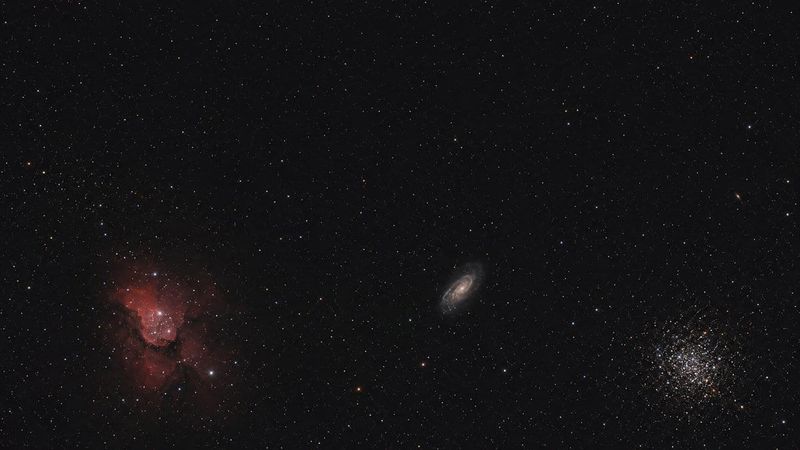
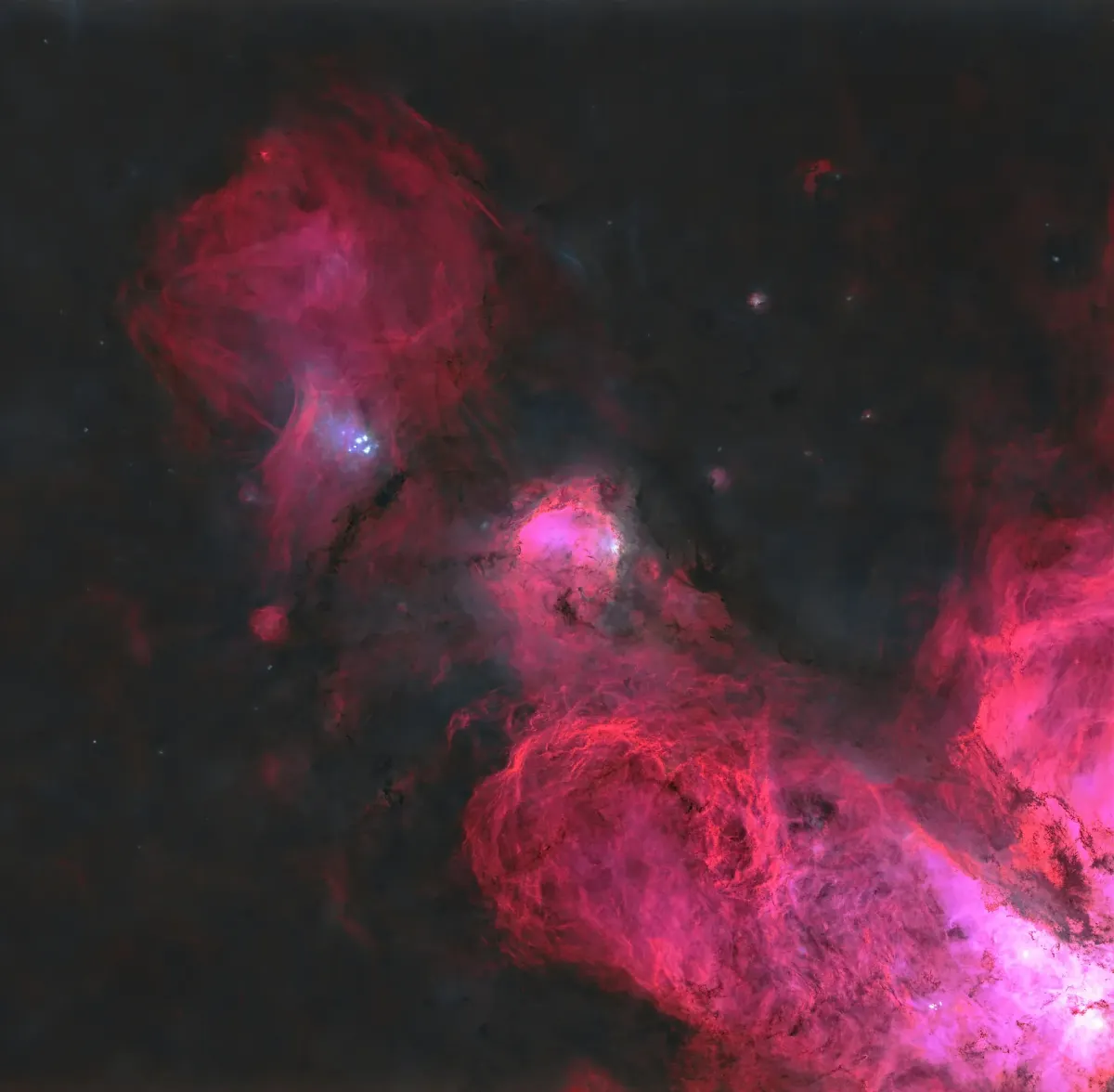
No — and this is the most important expectation to set. Through the eyepiece, almost all galaxies and nebulae appear as faint grey or grey-green smudges, not the vivid Hubble-style colors you see in photographs. Your eye simply is not sensitive enough to register color at low light levels. Those colors are real, but you only capture them with EAA or long-exposure imaging. Aperture buys you brightness and detail, not color.
How do I find objects with a Dobsonian without GoTo?
By star-hopping: you use a Telrad or red-dot finder and a star chart or app to hop from bright naked-eye stars to your target, step by step. It is a learnable skill that most observers come to enjoy. If you would rather skip the learning curve, a smartphone plate-solving system like StarSense Explorer guides you to targets with an on-screen arrow.
Why are my planet views blurry at high power?
Usually one of two things. First, a warm mirror: if the scope has not cooled to the outside air (30–60 minutes for an 8-inch, longer for bigger), tube currents smear the detail. Second, atmospheric seeing — turbulence in the air itself — which no telescope can fix and which varies night to night. Let the mirror cool, and on a steady night the same scope can look transformed.
How heavy is an 8-inch Dobsonian, and is it a two-person lift?
No, an 8-inch is a comfortable one-person carry in two pieces: the optical tube weighs roughly 20 lb and the rocker base another 20 lb or so, so you carry them out separately and assemble in seconds. A 10-inch is heavier but still manageable; 12-inch and up is where carrying gets serious and collapsible or truss designs earn their keep.
Does a Dobsonian need collimation?
Yes — like any Newtonian reflector, a Dobsonian needs its mirrors aligned (collimated) for sharp views. It is a quick routine task taking a few minutes with a laser collimator or Cheshire eyepiece. Solid-tube Dobs hold alignment well; truss Dobs benefit from a quick check at each setup.


&body=Dobsonian%20Telescopes%3A%20The%20Best%20Beginner%20Telescope%2C%20Explained%20(2026)%20%E2%80%94%20A%20Dobsonian%20telescope%20is%20a%20Newtonian%20reflector%20on%20a%20low-cost%20rocker-box%20mount.%20Learn%20why%20it%20is%20the%20best%20beginner%20telescope%20and%20best%20value%20pick%20in%202026.%20https%3A%2F%2Fstellarnomads.com%2Fdobsonian-telescope%2F%20Image%3A%20https%3A%2F%2Fstorage.ghost.io%2Fc%2Fbf%2F0d%2Fbf0d5d59-0433-4995-b3fa-4f41b743ef1b%2Fcontent%2Fimages%2F2026%2F07%2Fdobsonian-telescope-hero-1.webp)