Quick answer: The Big Dipper is a pattern of seven bright stars forming the hindquarters and tail of the constellation Ursa Major, the great bear. Known as the Plough in Britain, it’s the most recognizable star pattern in the northern sky — and the sky’s great signpost, pointing the way to Polaris, Arcturus, and half a dozen other landmarks.
The Big Dipper is the first star pattern most people in the Northern Hemisphere ever learn — and it repays that early friendship for a lifetime. It finds north for you, calibrates your sense of the seasons, tests your eyesight with a hidden double star, and parks two of the finest galaxies in the sky just off its bowl. This 2026 guide covers the Big Dipper’s seven stars by name, how to navigate with it, the bear myths behind it, and how to photograph both the pattern and the deep-sky treasures inside it.
Table of contents
- What is the Big Dipper?
- Big Dipper key facts
- The seven stars of the Big Dipper
- How to find the Big Dipper
- The sky’s great signpost
- The Big Dipper through the seasons
- Ursa Major and the myths of the great bear
- Deep-sky objects in and around the Dipper
- Photographing the Big Dipper
- Big Dipper FAQ
What is the Big Dipper?
The Big Dipper is an asterism — a famous informal star pattern — not a constellation in its own right. Its seven stars mark the hindquarters and long tail of Ursa Major, the great bear, third-largest of the 88 official constellations. Four stars outline the Dipper’s bowl; three trace the bent handle.
Different cultures see different tools in the same seven stars. Britain and Ireland see the Plough; Germany and much of Europe see a great wagon; older English tradition called it Charles’s Wain. In China these stars are Beidou, the Northern Dipper — important enough that China’s satellite-navigation system is named after them. Enslaved people escaping north on the Underground Railroad sang of it as the Drinking Gourd: follow it, and you walk toward freedom.


Big Dipper key facts
| Type | Asterism (informal star pattern), not an official constellation |
| Parent constellation | Ursa Major, the great bear |
| Number of stars | 7 — all around second magnitude |
| Brightest star | Alioth (magnitude 1.77), first star of the handle |
| Other names | The Plough (UK), Charles’s Wain, the Great Wagon, Beidou, the Drinking Gourd |
| Visibility | Circumpolar north of about 41°N; seasonal further south |
| Best evening views | March–June, when it rides high overhead |
| Famous for | Pointing to Polaris; the Mizar–Alcor double; galaxies M81, M82, and M101 |
The seven stars of the Big Dipper
Every Big Dipper star has an Arabic-rooted name and a personality of its own. From the front lip of the bowl to the tip of the handle:
| Star | Designation | Magnitude | Distance | What it is |
|---|---|---|---|---|
| Dubhe | Alpha UMa | 1.79 | ~123 ly | Orange giant; top pointer star |
| Merak | Beta UMa | 2.37 | ~80 ly | White star; bottom pointer star |
| Phecda | Gamma UMa | 2.44 | ~83 ly | White star at the bowl’s base |
| Megrez | Delta UMa | 3.31 | ~80 ly | Faintest of the seven; bowl-handle joint |
| Alioth | Epsilon UMa | 1.77 | ~81 ly | Brightest of the seven; peculiar magnetic star |
| Mizar | Zeta UMa | 2.27 | ~83 ly | Famous double with Alcor; a quadruple system |
| Alkaid | Eta UMa | 1.86 | ~104 ly | Hot blue star at the handle’s tip |
Look closely at Mizar, the middle handle star, and you’ll spot a faint companion riding beside it: Alcor. The pair — the “horse and rider” — was an eyesight test for ancient armies, and there’s more hiding there than the ancients knew: Mizar was the first double star ever resolved by telescope and the first spectroscopic binary ever discovered. Count the components today and Mizar–Alcor is a six-star family.


One more secret: the Big Dipper is mostly a real family. The middle five stars — Merak through Mizar — were born together and still drift through space as a group, the Ursa Major Moving Group, the nearest star cluster remnant to Earth. Dubhe and Alkaid, the two end stars, are unrelated and travel the opposite way — so over the next 100,000 years the familiar Dipper will slowly bend out of shape. Enjoy it while it lasts; our guide to how stars live and move explains why patterns like this are temporary.
The names themselves sketch the bear the Arabs inherited from Ptolemy: Dubhe is “the bear,” Merak “the loins of the bear,” Phecda “the thigh,” Megrez “the root of the tail,” and Mizar “the waistband.” Alkaid breaks the pattern beautifully — it means “the leader of the mourning maidens,” from an older Arabic sky-story in which the bowl was a funeral bier followed by three mourners. Two figures, one set of stars, a thousand years apart.
How to find the Big Dipper
Face north on any clear evening and look for seven bright stars forming a giant saucepan — from mid-northern latitudes you can hardly miss it. In spring it hangs high overhead, sometimes upside down; in autumn it skims low along the northern horizon. If trees or buildings block your north view in fall, wait a few hours: the Dipper wheels counterclockwise around Polaris and climbs through the night.
North of about latitude 41°N — Madrid, New York, Beijing — the Big Dipper is circumpolar and never sets. From the southern United States and similar latitudes it dips partly below the horizon on autumn evenings, and from south of the equator it’s a rare low-northern visitor at best.
The sky’s great signpost
The Big Dipper’s real superpower is what it points to. Learn three tricks and you can navigate the entire northern sky from this one pattern:
- Find north: extend the two “pointer” stars — Merak to Dubhe — five times their separation to land on Polaris, the North Star, at the tip of the Little Dipper’s handle.
- Arc to Arcturus: follow the curve of the Dipper’s handle away from the bowl and it sweeps into Arcturus, the brightest star of the northern sky, in Boötes.
- Spike to Spica: keep that same arc going past Arcturus and it drives on to Spica, the blue heart of Virgo.
- Leak on Leo: imagine the bowl springing a hole — the drip falls onto the back of Leo the lion, whose sickle-shaped head and bright Regulus sit south of the bowl.


Opposite the Dipper, on the far side of Polaris, sits the “W” of Cassiopeia — when one rides high, the other rides low, so between them you always have a northern landmark. This is exactly how stargazers learned the sky for centuries, star-hopping from pattern to pattern.
The Big Dipper through the seasons
Because Earth orbits the Sun, the Dipper’s evening position shifts through the year — and it makes a wonderfully reliable seasonal clock. The old rule is “spring up, fall down”: on spring evenings the Dipper soars near the zenith, and on autumn evenings it hugs the northern horizon. In winter it stands on its handle in the northeast; in summer the bowl tips downward in the northwest.
Watch it through one full night and you’ll see the same rotation in miniature: the whole pattern wheels counterclockwise around Polaris, a quarter turn every six hours. The Big Dipper is a clock, a compass, and a calendar in seven stars.
That’s not a metaphor — people genuinely told time by it. Before cheap watches, farmers and sailors read the hour from the angle of the pointer stars around Polaris, and a pocket gadget called a nocturnal turned the trick into an instrument: set the date, sight Polaris through the center, rotate the arm to the pointers, and read the hour off the dial. You can still do a rough version by eye once you know the Dipper makes one full counterclockwise turn per day.
Ursa Major and the myths of the great bear
The parent constellation, Ursa Major, is one of the oldest figures in the sky, catalogued by Ptolemy and almost certainly far older. In the Greek telling, Zeus fell for the nymph Callisto; a jealous Hera turned her into a bear, and Zeus flung her into the heavens to save her — her son Arcas became the nearby little bear. The bear’s improbably long tail? Blame the throw.
Remarkably, cultures on opposite sides of the Atlantic both saw a bear here. In several Native American traditions the bowl is a great bear pursued by three hunters — the handle stars — whose autumn hunt explains why the leaves turn red when the constellation sinks low. That two unconnected worlds told bear stories about the same stars is one of astronomy’s favorite mysteries, possibly a story carried across the Bering land bridge in the last Ice Age.
Deep-sky objects in and around the Dipper
The Big Dipper’s region is galaxy country — far from the dusty plane of the Milky Way, telescopes here punch clean out into deep space. Four targets headline the tour:
- M81 (Bode’s Galaxy) — a grand-design spiral 12 million light-years away, bright enough for binoculars from dark skies.
- M82 (the Cigar Galaxy) — M81’s chaotic neighbor, a starburst galaxy blowing itself apart in the same telescope field. The pair is the finest two-galaxy view in the northern sky.
- M101 (the Pinwheel Galaxy) — a huge face-on spiral floating just above the handle.
- M97 (the Owl Nebula) — a round planetary nebula with two dark “eyes,” below the bowl.


Just off the handle’s tip, in neighboring Canes Venatici, waits the Whirlpool Galaxy (M51) — and if you want the full shopping list, our guide to the Messier catalog maps all of it. There’s even a poetic footnote: the Hubble Deep Field, the image that first revealed thousands of galaxies in a speck of “empty” sky, was taken just above the Big Dipper’s handle.
Photographing the Big Dipper
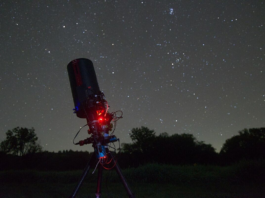
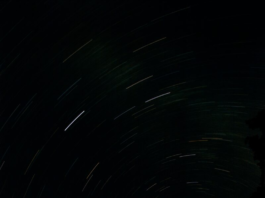
A camera on a tripod is all the Big Dipper asks for. A 24–35mm lens frames the whole asterism with landscape beneath it; 10–15 seconds at ISO 1600–3200 freezes the stars before Earth’s rotation smears them. Preview how the pattern fits your sensor with our field-of-view simulator, and plan exposures with the astrophotography calculator hub.
The classic exposure rule of thumb: divide 500 by your focal length for the longest untrailed exposure in seconds — about 20 seconds at 24mm. Shoot RAW, focus manually on a bright Dipper star with live view at maximum zoom, and take twenty frames instead of one: stacking them later crushes the noise. In spring, when the Dipper rides overhead, include a foreground; in autumn, its low northern posture makes a beautiful skyline composition.
With a tracking mount and a telescope, graduate to the galaxies: M81 and M82 fit together in one field at 400–800mm and reward hours of exposure — they’re spring targets we’ll cover in dedicated imaging guides. And don’t skip the simplest trophy of all: a 200mm shot of Mizar and Alcor, the double star you just split with your own eyes.
Big Dipper FAQ
Is the Big Dipper a constellation?
No — it’s an asterism, an informal pattern that forms only part of the official constellation Ursa Major, the great bear. The Dipper’s seven stars mark the bear’s hindquarters and tail; the full constellation is nearly three times larger.
What are the seven stars of the Big Dipper?
From the bowl’s lip to the handle’s tip: Dubhe, Merak, Phecda, Megrez, Alioth, Mizar, and Alkaid. Alioth is the brightest at magnitude 1.77 and Megrez the faintest at 3.31. Merak and Dubhe are the “pointers” that aim at Polaris.
Are the Big Dipper and the Plough the same thing?
Yes. “The Plough” is simply the British and Irish name for the same seven stars; other cultures see a wagon, a ladle, or a drinking gourd. Whatever the name, it’s the same asterism within Ursa Major.
Why is the Big Dipper sometimes upside down?
Because it circles Polaris once a day and shifts with the seasons. On spring evenings it rides high and inverted; on autumn evenings it sits low and right-side up. The rule of thumb is “spring up, fall down.”
Can you see the Big Dipper all year?
North of about latitude 41°N, yes — it’s circumpolar and never sets, though it rides low on autumn evenings. From the southern United States it briefly dips below the horizon, and from the Southern Hemisphere it’s essentially out of view.
What are Mizar and Alcor?
The double star in the middle of the Dipper’s handle — a classic naked-eye vision test. Telescopes reveal Mizar itself is a quadruple system, and with Alcor’s pair the “horse and rider” is really six stars traveling together 83 light-years away.
About the author — Hamza is an astrophotographer who has been imaging the night sky since 2008. He operates a remote deep-sky rig at Deepsky Chile (a 12.5″ Alluna Ritchey-Chrétien on a Paramount MX+ with an SBIG STL-11000 camera) and shares his work on Instagram @stellar.nomads.