The Messier objects are a list of 110 of the brightest deep-sky objects — galaxies, nebulae, and star clusters — catalogued by the French astronomer Charles Messier in the late 1700s. Today the Messier catalog is the most famous beginner’s checklist in all of astronomy: every entry is bright enough to track down with a small telescope, and together they form a perfect guided tour of the night sky across the whole year.
I have spent more than fifteen years observing and photographing these objects, and they are still where I send every beginner who asks “what should I point my telescope at?” The list is short enough to be achievable, varied enough to teach you the whole sky, and packed with genuine showpieces. This guide explains what the Messier objects actually are, breaks down the different types, highlights the ones to see first, and tells the story of the comet hunter who accidentally created the most useful list in amateur astronomy.
In This Guide
- What Are the Messier Objects?
- The Messier Catalog at a Glance
- The Types of Messier Objects
- Famous Messier Objects to See First
- Who Was Charles Messier?
- The Accidental Catalog
- How to Observe Messier Objects
- The Messier Marathon
- Frequently Asked Questions
What Are the Messier Objects?
A Messier object is any of the 110 deep-sky targets in the catalogue compiled by Charles Messier and his colleague Pierre Méchain between 1774 and 1781. Each one is a “fixed” object — a galaxy, a nebula, or a cluster of stars — as opposed to the comets Messier was actually hunting. The objects are numbered M1 through M110 in roughly the order they were added to the list.
What makes the catalogue so enduringly useful is not the science behind it but the practical filter Messier applied: he only listed things bright enough to be mistaken for a comet through an 18th-century telescope. That accidental criterion means almost every Messier object is within reach of modern binoculars or a beginner’s telescope under a reasonably dark sky. The catalogue is, in effect, a curated list of “the good stuff” — the deep-sky objects most worth a newcomer’s time.
The Messier Catalog at a Glance
- Number of objects: 110 (Messier’s own editions reached 103; M104–M110 were added later from his and Méchain’s notes)
- Catalogued by: Charles Messier, with Pierre Méchain
- First published: 1774; expanded editions through 1781
- Object types: galaxies, globular clusters, open clusters, nebulae, and one supernova remnant
- Brightness range: from naked-eye (the Pleiades, magnitude ~1.6) down to about magnitude 10
- Designations: M1 through M110
- Coverage: Northern and equatorial skies (Messier observed from Paris, so far-southern objects are absent)
The Types of Messier Objects
Although Messier lumped everything together as “nebulae and star clusters,” we now know his catalogue contains several very different kinds of object. Understanding the types is the fastest way to make sense of the list.
Open star clusters are loose groups of young stars born from the same cloud of gas. They are the easiest Messier objects for beginners — bright, large, and rewarding even in binoculars. The Pleiades (M45) and the Beehive Cluster (M44) are the standouts. To understand what these glittering groups really are, it helps to know what a star is and how stars form together.
Globular clusters are dense, spherical swarms of hundreds of thousands of ancient stars, bound tightly by gravity. The Great Hercules Cluster (M13) and M22 are the showpieces — through a telescope they resolve into a sparkling ball of stars that no photograph quite does justice.
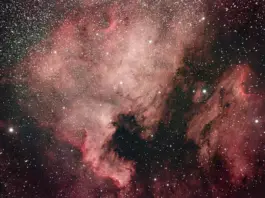
Nebulae are clouds of gas and dust — some glowing as stellar nurseries, others the cast-off shells of dying stars. The Orion Nebula (M42), the Ring Nebula (M57), and the Dumbbell Nebula (M27) are all in the catalogue. If you want the full picture of these objects, see our guide to what a nebula is.
Galaxies are entire island universes of billions of stars, far beyond the Milky Way. The catalogue is rich with them: the Andromeda Galaxy (M31), the Whirlpool Galaxy (M51), the Sombrero Galaxy (M104), and the spiral Messier 106 are among the most photographed objects in the sky.


Supernova remnant. The catalogue contains exactly one: the Crab Nebula (M1), the expanding wreckage of a star that exploded in the year 1054, an event recorded by Chinese astronomers at the time. It was the first object Messier added to his list — the spark for the whole project.
Famous Messier Objects to See First
If you are just starting out, do not try to see all 110 at once. Begin with these crowd-pleasers — they are bright, easy to find, and they show off the variety of the catalogue.
- M31 — the Andromeda Galaxy: the nearest large galaxy and the most distant object visible to the naked eye.
- M42 — the Orion Nebula: a glowing stellar nursery, the showpiece of the winter sky.
- M45 — the Pleiades: a brilliant naked-eye star cluster, stunning in binoculars.
- M13 — the Great Hercules Cluster: the finest globular cluster in the northern sky.
- M51 — the Whirlpool Galaxy: a textbook face-on spiral with a companion.
- M104 — the Sombrero Galaxy: an edge-on spiral with a dramatic dust lane.


Who Was Charles Messier?
Charles Messier was born in Badonviller, France, in 1730, the tenth of twelve children. His fascination with the sky was sparked by two spectacular comets — the Great Comet of 1744, with its multiple tails, and an annular solar eclipse he watched from his hometown. In 1751 he moved to Paris and took a position under Joseph-Nicolas Delisle, the French Navy’s astronomer, where his job was to meticulously record the positions of the Moon and planets.
That training made him an extraordinary observer. Over his career Messier discovered or co-discovered around 13 comets — enough that King Louis XV reportedly nicknamed him “the Ferret of Comets.” He worked through the French Revolution and continued observing into old age despite poor health and chronic money troubles, dying in Paris in 1817. Ironically, the comets he chased so hard are largely forgotten, while the list he made on the side became his lasting monument — a story he shares with many of the great astronomers in history.
The Accidental Catalog: A Comet Hunter’s Side Project
Here is the twist that makes the Messier catalogue so charming: Messier never set out to study galaxies or nebulae. He was hunting comets, and these faint, fuzzy patches kept fooling him. A new comet appears as a small smudge that moves against the stars over several nights; the trouble is that a distant galaxy or nebula looks almost identical at first glance, except that it never moves.
After being repeatedly fooled — most famously by the Crab Nebula while tracking Halley’s Comet in 1758 — Messier began noting down these impostors so he would not waste time on them again. His first catalogue of 45 objects appeared in 1774. With his observing partner Pierre Méchain feeding him new finds, the list grew to 103 entries by 1781. The “nuisances” he wanted to avoid turned out to be the most important objects in the sky.
How to Observe Messier Objects
You do not need expensive equipment to start working through the Messier catalogue — that is the whole point of it. A pair of 10×50 binoculars will show you dozens of them, and a small 4- to 6-inch telescope opens up nearly the entire list. Here is how to get the most out of them:
- Chase dark skies. Light pollution is the single biggest obstacle to seeing faint galaxies and nebulae. Even a short drive to a darker site transforms the view — our guide to light pollution explains why.
- Match the season. Different objects are visible at different times of year. Orion’s M42 dominates winter, the galaxies of Virgo and Coma rule spring, and the rich star clouds of Sagittarius own the summer.
- Pick the right telescope. Wide, rich-field views suit clusters, while galaxies reward more aperture. If you are still choosing gear, browse our overview of telescopes.
- Frame before you shoot. If you plan to photograph Messier objects, check how each one fits your camera and scope with a telescope field of view calculator before the session.
Messier Objects Season by Season
Because Messier observed from Paris, the catalogue spreads right around the northern sky, which means there are rewarding targets in every season. Planning your observing by the calendar is the easiest way to work through the list without frustration — instead of one daunting list of 110 objects, you have four manageable seasonal projects.
- Winter belongs to Orion. The Orion Nebula (M42), the brilliant Pleiades cluster (M45), and the Crab Nebula (M1) all ride high on cold, clear evenings, alongside the open clusters M36, M37 and M38 in Auriga.
- Spring is galaxy season. The realm of Virgo and Coma Berenices is packed with Messier galaxies, including the Whirlpool (M51), the Sombrero (M104), Messier 106, and the bright pair M81 and M82 in Ursa Major.
- Summer brings the glowing heart of the Milky Way. The Hercules Cluster (M13), the Lagoon Nebula (M8), the Ring Nebula (M57), the Dumbbell Nebula (M27), and the rich star clouds of Sagittarius dominate warm nights.
- Autumn is the time for the Andromeda Galaxy (M31), its companion M32, the Triangulum Galaxy (M33), and the fine globular cluster M15 in Pegasus.
Keeping a simple seasonal checklist means you will almost always have a Messier target overhead, whatever the month — and it builds the sky-knowledge that makes every future observing session faster and more rewarding.
The Messier Marathon
For experienced observers, the catalogue offers one of amateur astronomy’s great challenges: the Messier Marathon. On a single moonless night around late March, from mid-northern latitudes, it is just possible to see all 110 objects between dusk and dawn as the sky wheels overhead. It demands careful planning, a memorised observing order, and a lot of coffee — but completing one is a genuine rite of passage. Even if you never attempt the full marathon, ticking off Messier objects one season at a time is the single best way to learn your way around the night sky.
Frequently Asked Questions
How many Messier objects are there?
There are 110 Messier objects, numbered M1 to M110. Charles Messier’s own catalogue reached 103 entries; the final seven were added later by historians from his and Pierre Méchain’s observations.
What is a Messier object?
A Messier object is a bright deep-sky object — a galaxy, nebula, or star cluster — listed in Charles Messier’s 18th-century catalogue of objects that could be mistaken for comets.
What is the brightest Messier object?
The brightest is M45, the Pleiades, an open star cluster shining at about magnitude 1.6 — easily visible to the naked eye even from suburban skies.
Can you see Messier objects with binoculars?
Yes. Many Messier objects, including the Pleiades (M45), the Andromeda Galaxy (M31), and the Orion Nebula (M42), are easy targets in ordinary 10×50 binoculars under a dark sky.
Who was Charles Messier?
Charles Messier (1730–1817) was a French astronomer and comet hunter who compiled the famous Messier catalogue of deep-sky objects, originally to avoid confusing them with the comets he was searching for.
What is the difference between Messier and NGC objects?
Messier objects are the 110 bright targets in Charles Messier’s 18th-century list. The New General Catalogue (NGC) is a much larger 19th-century catalogue of nearly 8,000 objects. Most Messier objects also carry an NGC number — for example, Messier 106 is also known as NGC 4258, and the Andromeda Galaxy (M31) is NGC 224.
A List That Still Matters
More than two centuries after Charles Messier scribbled down his list of comet impostors, the Messier catalogue remains the perfect on-ramp to the night sky. It is curated, achievable, and endlessly rewarding — a single list that takes you from glittering star clusters to vast spiral galaxies millions of light-years away. Whether you observe them through an eyepiece or photograph them frame by frame, working through the Messier objects connects you to a quiet 18th-century comet hunter and to the deep universe he never fully understood he had charted. Start with the bright ones, take your time, and let the catalogue teach you the sky. For an authoritative reference on each object, NASA maintains a complete Hubble Messier catalogue.