Quick answer: Johannes Kepler (1571–1630) was a German astronomer and mathematician who discovered the three laws of planetary motion — proving that planets orbit the Sun in ellipses, not perfect circles. Working from the precise observations of Tycho Brahe, he turned astronomy from geometry into physics and laid the groundwork that Isaac Newton would later complete with gravity.
Johannes Kepler is one of the towering figures of the Scientific Revolution, yet his greatest achievement began as a frustrating eight-year struggle to explain the orbit of a single planet: Mars. When he finally cracked it, he overturned two thousand years of assumptions and gave humanity its first set of physical laws governing the heavens. This guide covers who he was, the three laws that made him famous, his many other discoveries, and why his name is still on a NASA spacecraft four centuries later.
Who was Johannes Kepler?
Johannes Kepler was born on December 27, 1571, in the free imperial city of Weil der Stadt, in what is now Germany. Born prematurely into a troubled, often impoverished family, he was a sickly child whose eyesight was permanently damaged by a bout of smallpox. He found his escape in the sky: his mother showed him the Great Comet of 1577 and a lunar eclipse, encounters he remembered for the rest of his life. A scholarship took him to the University of Tübingen, where the brilliant young Kepler trained for the Lutheran ministry but excelled at mathematics.
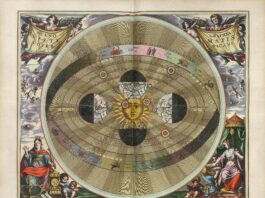
It was at Tübingen that his teacher Michael Maestlin privately introduced him to the radical Sun-centred model of Nicolaus Copernicus. Kepler embraced it immediately and never let go. Sent to teach mathematics in Graz in 1594, he published Mysterium Cosmographicum in 1596 — the first openly Copernican work by an astronomer since Copernicus himself. Its central idea, that the spacing of the planetary orbits was set by the five Platonic solids nested inside one another, was wrong, but it announced a daring new mind and earned him the attention of the greatest observational astronomer of the age.
As the Counter-Reformation tightened its grip, Kepler — a committed Lutheran — was expelled from Catholic Graz in 1600. The upheaval pushed him toward the imperial capital, Prague, and toward the partnership that would define his career. For Kepler, deeply religious throughout his life, uncovering the mathematical order of the cosmos was itself a form of worship — he believed he was, in his own words, “thinking God’s thoughts after him.”
Kepler and Tycho Brahe: the data that changed everything
In 1600, Kepler arrived in Prague to work as an assistant to Tycho Brahe, the imperial mathematician to Holy Roman Emperor Rudolf II. Tycho had spent decades recording the positions of the planets with an accuracy never before achieved — all with the naked eye and enormous instruments, before the telescope existed. A proud and secretive man, he guarded that data jealously, releasing it to his ambitious young assistant only in fragments.
When Tycho died unexpectedly in 1601, Kepler succeeded him as imperial mathematician and gained access to the complete archive. It was the most valuable inheritance in the history of astronomy. Tycho’s measurements of Mars were so precise that Kepler could not force them to fit the circular orbits that everyone, Copernicus included, had assumed. A stubborn discrepancy of just eight arc-minutes — a tiny fraction of the width of the full Moon — refused to disappear. Rather than dismiss it as observational error, Kepler trusted the data and abandoned the circle. That single decision changed science forever.
Kepler later called this effort his “war on Mars.” For nearly eight years he filled hundreds of pages with failed calculations, testing scheme after scheme before the numbers forced him to an unexpected conclusion. He published the result in 1609 in Astronomia Nova (“A New Astronomy”) — a book that, for the first time, treated planetary motion as a problem of physical cause rather than pure geometry.
Kepler’s three laws of planetary motion
Kepler’s laws describe how planets move around the Sun. They were the first natural laws expressed as precise mathematics, and they remain accurate enough that NASA still uses them to plan missions. For reference, see NASA’s plain-language guide to orbits and Kepler’s laws and the detailed mathematical formulation on Wikipedia alongside the summary below.
1. The Law of Ellipses (1609)
Every planet orbits the Sun along an ellipse, with the Sun at one of the two foci. This shattered the ancient belief — held from Aristotle through Copernicus — that celestial bodies must move in perfect circles. For most planets the ellipse is so close to a circle that the difference is invisible to the eye; but Mars has a more elongated orbit, and that small departure was just measurable in Tycho’s data. It is why Mars, of all the planets, was the key that unlocked the puzzle. The law was published in Astronomia Nova.
2. The Law of Equal Areas (1609)
A line joining a planet to the Sun sweeps out equal areas in equal intervals of time. In practical terms, a planet moves faster when it is closer to the Sun (at perihelion) and slower when it is farther away (at aphelion). This captured something profound: the Sun is not a passive centre but actively governs the speed of the planets. It was a physical relationship, not just a geometric pattern, and it pointed the way toward a force emanating from the Sun.
3. The Harmonic Law (1619)
The square of a planet’s orbital period is proportional to the cube of its average distance from the Sun (T² ∝ a³). Published a decade later in Harmonices Mundi, this law tied the entire Solar System together with a single equation. For example, knowing that Jupiter takes about 11.9 years to circle the Sun tells you at once that it orbits roughly 5.2 times farther out than Earth — a calculation that was impossible before Kepler. For the first time, astronomers could map the true proportions of the Solar System.
Kepler’s other contributions
The three laws would be legacy enough, but Kepler was extraordinarily prolific across many fields:
- Optics and the telescope. In Astronomiae Pars Optica (1604) he explained how the human eye forms an image on the retina, and in Dioptrice (1611) he designed the Keplerian telescope, using two convex lenses to give a wider field of view than Galileo‘s design. It quickly became the standard for astronomical instruments.
- The Rudolphine Tables (1627). Built on Tycho’s observations and Kepler’s own laws, these planetary tables were dramatically more accurate than anything before them — the practical proof that his elliptical system actually worked.
- Kepler’s Supernova (1604). He observed and described a brilliant new star, a supernova within our own galaxy. It remains the last supernova seen with the naked eye in the Milky Way to this day.
- The first work of science fiction. His posthumously published Somnium (1634) imagined a journey to the Moon and how the Earth would appear from its surface — a story that Carl Sagan and Isaac Asimov both credited as an early ancestor of science fiction.
- The Kepler conjecture (1611). He proposed that the most efficient way to stack identical spheres — think of oranges or cannonballs — is the familiar pyramid arrangement. Simple to state, it resisted rigorous mathematical proof until 1998, nearly four centuries later.
Kepler’s later years and death
Kepler achieved much of this against a backdrop of relentless hardship. Between 1615 and 1621 he was forced to defend his own mother, Katharina, against charges of witchcraft, securing her release only after she had been imprisoned and threatened with torture. The Thirty Years’ War repeatedly uprooted his family, destroyed his livelihood, and made it impossible to collect the salary the imperial treasury owed him. In his final years he worked as astrologer to the warlord Albrecht von Wallenstein, casting horoscopes to make ends meet while continuing his astronomical work. Kepler died in Regensburg on November 15, 1630, after falling ill on a journey to recover money he was owed. His grave was destroyed in the war and has never been found — but the epitaph he wrote for himself survives: “I measured the skies, now the shadows I measure.”
From Copernicus to Newton: Kepler’s place in history
Kepler is the crucial bridge in the story of modern astronomy. Copernicus had proposed a Sun-centred cosmos but kept the old circular orbits; Kepler replaced those circles with ellipses and made the model genuinely accurate. Where his contemporary Galileo Galilei provided the telescopic evidence for heliocentrism, Kepler provided the mathematical laws that described it.
Decades later, Isaac Newton showed that all three of Kepler’s laws follow directly from a single principle — universal gravitation. Kepler had discovered the rules; Newton explained the reason behind them. Together they form the foundation of celestial mechanics. This long chain of progress — from the Islamic Golden Age astronomers such as Al-Battani, through Copernicus, Tycho, Kepler and Galileo, to Newton — is told in full in our guide to the most famous astronomers in history.
Why Johannes Kepler still matters in 2026
Kepler’s laws are not historical curiosities — they are working tools. Every satellite, space probe and planetary mission is plotted using the same mathematics he derived from Tycho’s Mars data four centuries ago. When engineers calculate a transfer orbit to Mars or a gravity assist past Jupiter, they are, quite literally, using Kepler.
His name also rides on one of the most important instruments of the modern era: NASA’s Kepler Space Telescope. Between 2009 and 2018 it discovered more than 2,600 confirmed planets around other stars by watching for the tiny dips in starlight as those worlds passed in front of their suns — confirming that the laws Kepler found for our Solar System govern planetary systems across the galaxy. More than anyone, Kepler taught science a lesson that still defines it: trust the data, even when it forces you to abandon a belief you have held your entire life.
Frequently asked questions
When was Johannes Kepler born and when did he die?
He was born on December 27, 1571, in Weil der Stadt in the Holy Roman Empire (modern Germany), and died on November 15, 1630, in Regensburg.
What are Kepler’s three laws of planetary motion?
First, planets orbit the Sun in ellipses with the Sun at one focus. Second, a planet sweeps out equal areas in equal times, moving faster when it is closer to the Sun. Third, the square of a planet’s orbital period is proportional to the cube of its average distance from the Sun.
What did Johannes Kepler discover?
His central discovery was the three laws of planetary motion. He also designed the Keplerian telescope, explained how the eye forms images, compiled the highly accurate Rudolphine Tables, and observed and recorded the supernova of 1604.
Did Kepler work with Tycho Brahe?
Yes. Kepler became Tycho Brahe’s assistant in Prague in 1600 and inherited his decades of precise planetary observations after Tycho died in 1601. Those observations of Mars were the data from which Kepler derived his laws.
How did Kepler influence Isaac Newton?
Kepler described how the planets move; Newton later proved that all three of Kepler’s laws are natural consequences of his law of universal gravitation. Kepler’s work was the essential foundation for Newtonian physics.
Was Johannes Kepler an astrologer?
Yes — like most astronomers of his era, Kepler cast horoscopes, partly to earn a living. He was skeptical of much of astrology’s detail but believed the heavens influenced earthly events, a common view in his time.
Why are Kepler’s laws important?
They were the first laws of astronomy expressed as exact mathematics, and they remain the foundation of orbital mechanics today. Every spacecraft trajectory is calculated using them, and they allow astronomers to work out the distances and orbital periods of planets and distant exoplanets alike.
Keep exploring
Read more in our guide to the 30 most famous astronomers in history, or explore the lives of Nicolaus Copernicus, Galileo Galilei and Al-Battani. A full biography of Tycho Brahe — the man whose data made Kepler’s laws possible — is coming soon.